Is it Safe to use VPN while Completing Online Surveys?
Let’s talk about something I see asked all the time in survey-taking communities. “Can I use a VPN to protect my privacy?” or “What if I use a VPN to access surveys in other countries?”
I get the appeal that privacy matters and if you’ve seen higher-paying surveys available in other regions, the temptation is real. But before you flip that switch, we need to talk about what actually happens when you show up to a survey platform with a masked IP address.
I reached out to experts who actually understand how survey platforms work. No guesswork, no forum speculation. Every single expert I asked to said the same thing in different ways, using a VPN for online surveys is risky. Like, you’ll lose your account and your earnings.
Here’s what they want you to know:
You may lose Your Account
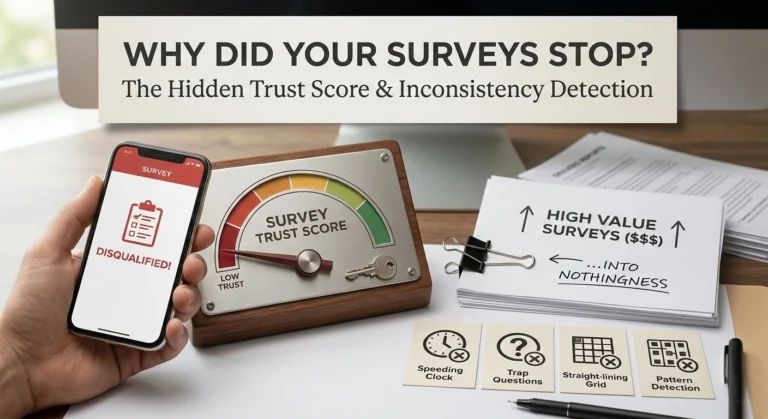
When using a VPN while taking surveys online – the risk of losing your account is high, since the main tenet of market research is that it requires the location of participants to be accurate. If a brand has chosen to pay for insight from a specific location and the participant is using a VPN, that data will be useless to the brand. To uphold the integrity of data for clients, most platforms have language in their terms of service that expressly forbids the use of a VPN.
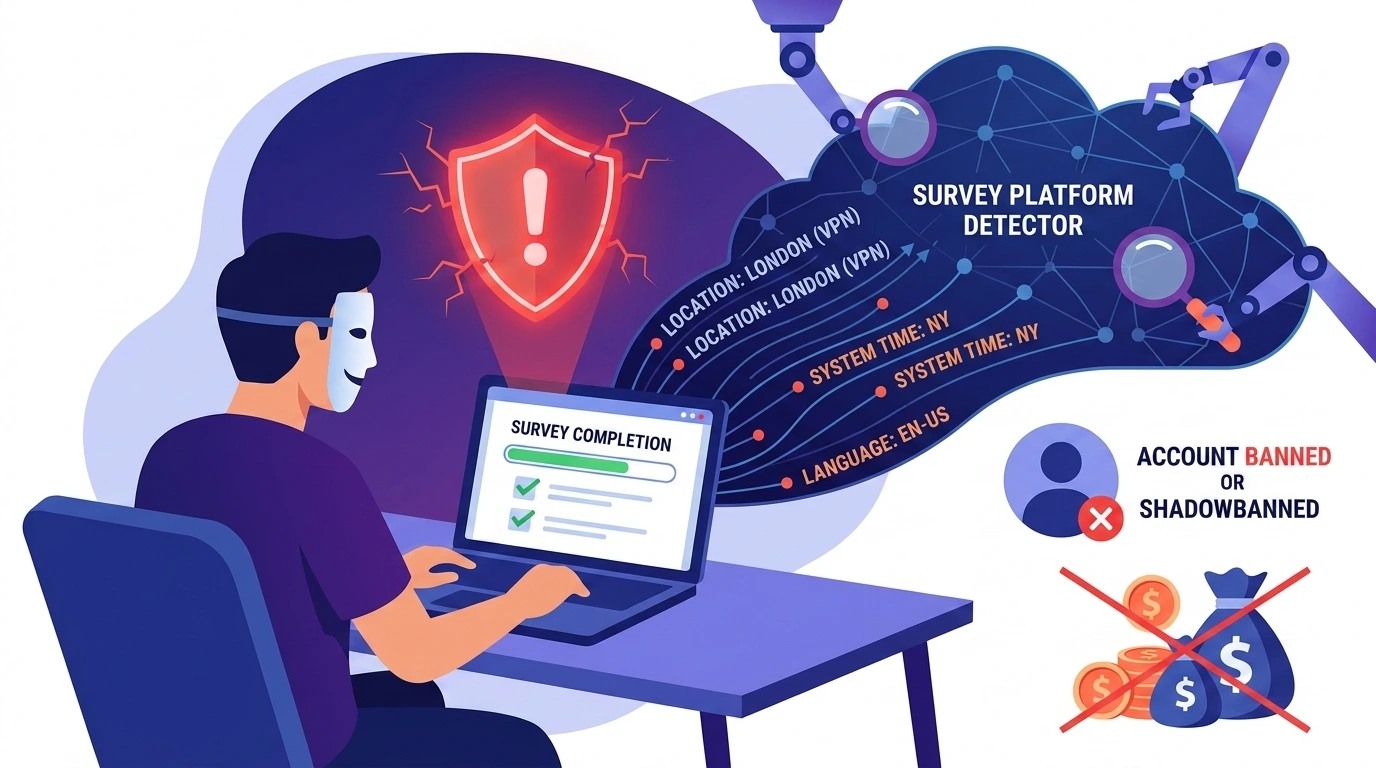
Platforms have numerous engineering layers that detect chaos traffic (not human traffic) and/or spoofed traffic. The major identifier they look for is IP intelligence; they map all incoming IP addresses to see if they are low-risk/risk-free (residential) vs high-risk (data centre). In addition to IP, they also use browser fingerprinting to look for anomalies; i.e. mismatched system time zone to location indicated. A large part of bot detection involves tracking user behaviour: example – speeds of survey completion that are impossible/too quick; method of mouse movement that is straight-line and does not have the subtle movement from jitter that would occur with normal human movement.
Once an account has been flagged, the response is automated and usually final. Most platforms will either suspend the account or ‘shadowban’ the participant (i.e. participant can continue to complete surveys, but will not receive a payout), and once an account has been flagged, most times by virtue of a flag a participant’s accrued earnings will permanently be forfeited, as there is no ethical way for a platform to bill clients for compromised data resulting from detection.
Data integrity is the only currency in the research industry. As detection technologies become smarter and the opportunities to find ways of avoiding detection get smaller, the risk of losing one’s account is far greater than any potential rewards associated with the use of a VPN.

Amit Agrawal, Founder & COO, Developers.dev
Survey Platforms will flag you
Using a VPN when taking an online survey may trigger a flag on the account and is likely not going to be safe. Always check the survey company’s “Terms of Service” prior to using any type of survey software or tools, and make sure you are in compliance with their requirements.
If you get flagged by the survey company, the best course of action would be to go back to the survey company website and complete whatever verification process they require. Typically, survey companies will limit their liability as it relates to disputes that occur outside of the survey company’s website. Therefore, do not send any information or transfer any payment processes to another platform (i.e., messaging apps), and please take time to review any communication that seems like it is asking you to take some kind of action urgently before you respond.

Silvia Lupone, Owner, Stingray Villa
Your Reponses will be Excluded
Using a VPN while completing paid or targeted online surveys can affect data quality and may cause your responses to be excluded, so I generally advise avoiding it when you want your responses counted. In my work using Fairing to collect unbiased survey data and applying machine learning to analyze large datasets, we focus on preserving clean respondent signals.
Survey platforms commonly apply analytics and machine learning to spot anomalous or automated behavior rather than relying on single indicators. When a response or account is flagged, platforms typically exclude those responses from reporting and may block or suspend the account from further participation.

Gursharan Singh, Co-Founder, WebSpero Solutions
Platforms care about quality of data
In most cases it is not advisable. Survey platforms are designed to protect data integrity, so they actively flag signals like inconsistent IP locations, device fingerprints, or traffic patterns that resemble automated responses. When an account is flagged, surveys are often rejected or the account is suspended. The underlying goal is simple. Survey providers care more about reliable data than participation volume.

Nicholas Gibson, Marketing Director, Stash + Lode
They treat it as location masking
Using a VPN for paid surveys is often not worth the risk because many platforms treat it as location masking, even if your intent is privacy. They flag it through IP reputation and ASN checks, geolocation mismatches, device and browser fingerprints, and behaviour signals like speed, repeat patterns, and inconsistent answers.
When you get flagged, the usual outcome is a disqualification, withheld reward, or an account hold while they review, and repeat flags can lead to closure. If you think you are being flagged, turn off VPNs and privacy relays, stay on one device and network, and ask support what rule you triggered instead of trying to brute-force it.

Hasan Can Soygök, Founder, Remotify
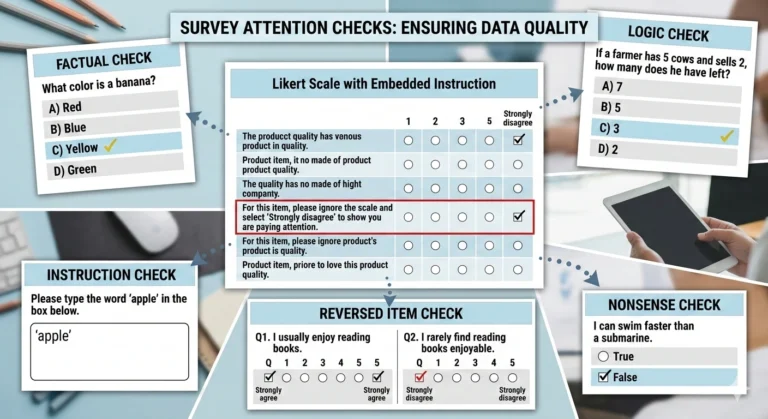
Aldo Read: What Happens If You Fail an Attention Check?
Why Platforms Care So Much
This is the part people miss. It’s not that survey companies are being controlling for no reason. They have clients paying for data from specific locations. A brand wants to know what people in Chicago think about their product. If you’re answering from Chicago but your IP says somewhere else, or worse, you’re actually in a different country entirely, that data is worthless. The brand paid for garbage.
As Nicholas Gibson stated:
“Survey providers care more about reliable data than participation volume.”
They’d rather have fewer respondents with clean data than thousands of responses they can’t trust.
How They Actually Catch You
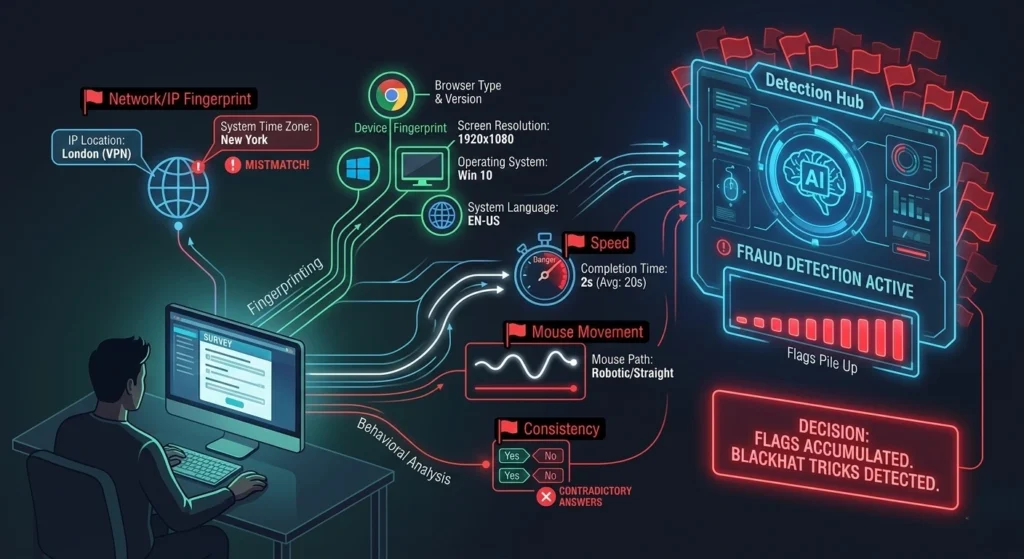
As said by Amit Agrawal and Hasan Can Soygök. They’re not just looking at your IP. They’re looking at everything, your browser settings, your time zone, your system language, your screen resolution. If your IP says London but your system time is set to New York, that’s a red sign.
They also fingerprint your device and not just your IP, but your browser, your screen resolution, your operating system, all of it. That fingerprint follows you even if you switch networks. So if you try to come back with a different VPN, they know it’s still you.
And then there’s the behavior stuff. How fast are you moving through surveys? Are you clicking answers in two seconds when it should take twenty? Is your mouse movement perfectly straight like a robot instead of that shaky, human jitter? Do your answers keep contradicting themselves?
They see all of it and when enough flags pile up, the system makes its decision.
It’s not one thing. It’s everything, all at once, analyzed by systems designed specifically to find people who use Blackhat tricks.
What Happens When You Get Flagged
A shadow ban is the worst case; you keep taking surveys thinking everything’s fine. You’re giving them your time, your opinions, your data and at the end? Nothing, no payout and you might not even know why.
The Terms You Probably Didn’t Read
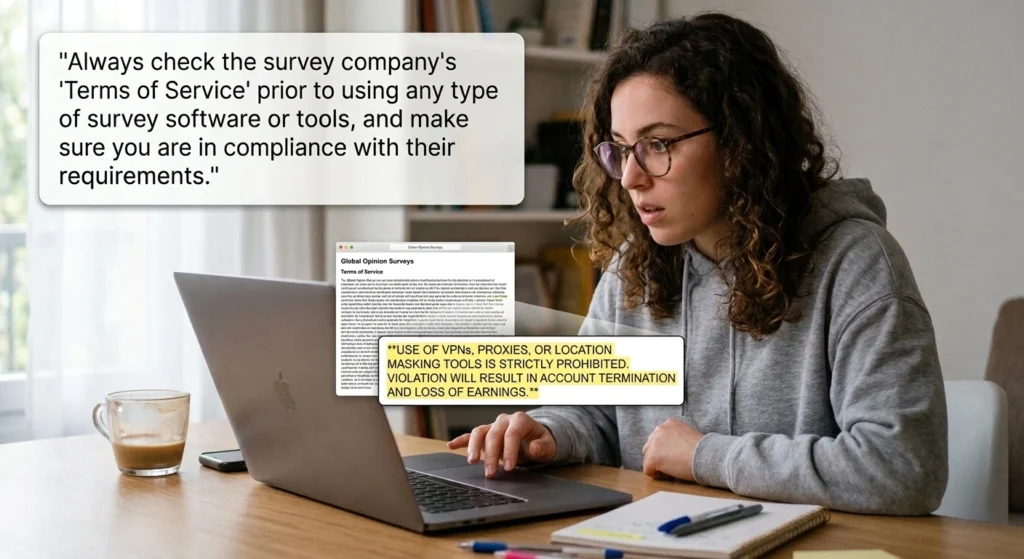
Silvia Lupone made a point that applies to more than just surveys:
“Always check the survey company’s ‘Terms of Service’ prior to using any type of survey software or tools, and make sure you are in compliance with their requirements.”
I know nobody reads terms of service. But in this case, the terms explicitly forbid VPN use almost every time. You agreed to it when you signed up you just didn’t know.
She also added a warning about recovery attempts that if you get flagged, deal with it through official channels. Don’t get scammed by someone promising to fix your account if you send them money or info.
But What About Privacy?
I know what some of you are thinking “I just want privacy I don’t want companies tracking me.”
Fair point but here’s the reality check from Hasan:
“Using a VPN for paid surveys is often not worth the risk because many platforms treat it as location masking, even if your intent is privacy.”
They don’t know your intent they only see the flags. Privacy is noble but on survey platforms, privacy looks exactly like fraud.
Final Verdict
So, it is clear that using VPN while taking online surveys is not a good practice as the platforms have layers of detection. The terms of service forbid it and the consequences are automated and final.
If privacy is your concern, consider this, survey platforms already have your data that’s the trade. You give them information; they give you rewards. Using a VPN doesn’t fix that transaction it just breaks the rules.
If you want to keep taking surveys, keep earning, and keep your account in good standing, turn the VPN off before you click that survey link.
I know that’s not what everyone wants to hear. But the experts are clear, the risk is real and once your account is gone, it’s not coming back.