How Does Inconsistent Answering affect Survey Eligibility?
You’re cruising through a survey about laundry detergent. Twenty minutes in, you hit submit expecting to see that sweet reward screen. Instead? “Disqualified.” Or worse, you don’t get disqualified today you just notice over the next few weeks that survey invitations have dried up completely.
But here’s what’s happening behind that screen, according to the people who actually build and run these systems.
I reached out to industry experts to understand what really goes on behind the screens of survey platforms. Here’s what they had to say about how your answers and your behavior affect your survey future.
And this was the question first of all:
How does inconsistent answering affect survey eligibility, account trust scores, or long-term survey availability? Specifically:
- Do survey platforms use algorithms to detect inconsistencies?
- Can inconsistent answers reduce future survey invitations?
- Are there behavioral patterns that trigger flags or account limitations?
- How sophisticated are fraud detection systems in the survey industry? Thank you for your time and expertise.
Let’s see their answers:
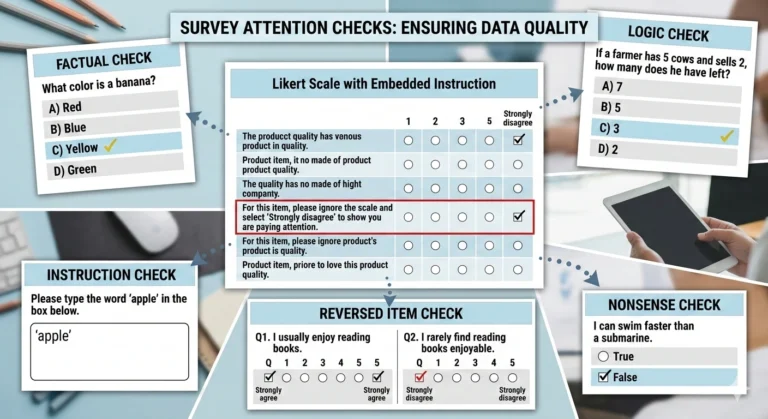
Question 1: Real-time validation systems of survey platforms cross-reference data points to validate that internal consistency exists. A survey will flag a respondent’s session for manual review or automatically reject the session based upon contradictory demographic information or the discovery of failure in “trap questions,” for example, asking age at the start of a survey and birth year at the end of a survey.
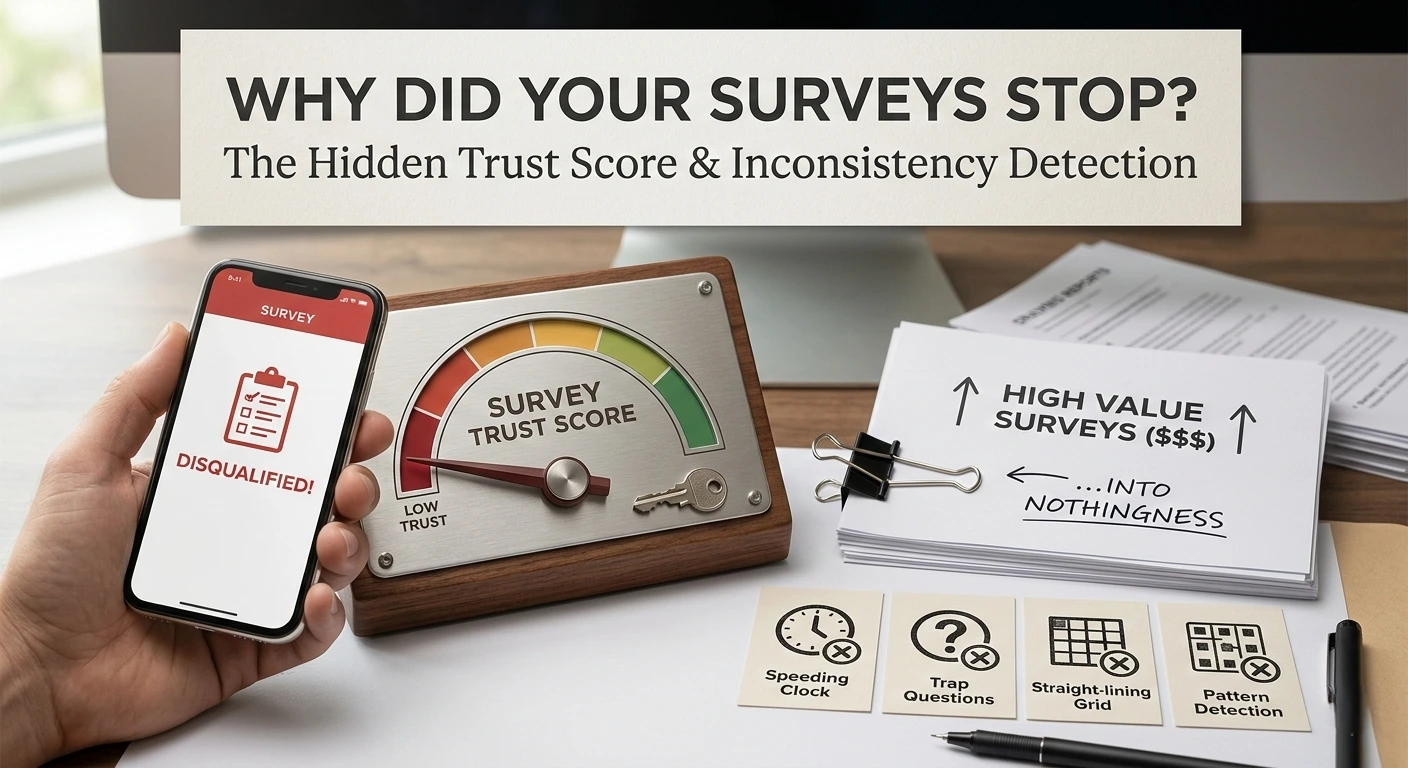
Question 2: Respondent inconsistencies are the leading cause for less survey invitations. Survey platforms create dynamic trust scores for every survey respondent and as trust scores decrease below a specific threshold level, the survey respondee will be removed from accessing high-value research pools which will help maintain the data integrity of the end client. Over an extended period of time, low trust scores will result in stopping the survey respondent entirely from being invited to take surveys.
Question 3: Behaviors such as speeding – survey completion time is significantly lower than the average reading time for survey respondents – are key indicators that the user’s account may be limited. Survey systems also look for straight-lining (multiple-choice responses through grids with the same response selected) when answering survey questions, and for patterned responding (respondent completes a survey in the same, predictable visual pattern regardless of the content of the survey questions).
Question 4: The fraud detection systems in the survey industry are becoming much more sophisticated by using device fingerprinting technology, IP address reputation checks and numerous other technologies to prevent a user from creating multiple accounts to take surveys. In addition, survey platforms use natural language processing (NLP) technology on open-ended responses to ensure that responses are not only grammatically correct, but that they are also contextually relevant to the survey questions they are associated with.
The management of the digital interaction requires a continuous balance between the automated guardrails and human oversight. Even though algorithms can identify a significant amount of technical inconsistencies, the primary trust is in preserving the value of the genuine human respondent provides in a mostly automated world.

Pratik Singh Raguwanshi, Manager, Digital Experience at Live Help India.
Behind the Scenes of Survey Quality Control
At Software House, we built fraud detection systems for online survey platforms, so I can speak directly to how these algorithms work behind the scenes. Yes, survey platforms absolutely use algorithms to detect inconsistencies, and they are far more sophisticated than most respondents realize.
The most common detection method is cross-referencing answers to trap questions placed throughout a survey. These are questions that ask the same thing in different ways at different points. If you say you are 35 in one section and select a 25 to 30 age bracket elsewhere, the system flags your responses automatically. But the algorithms go much deeper than simple contradiction checks. Modern platforms analyze response timing patterns.
If you complete a 15-minute survey in 3 minutes, the system assigns a low-quality score. They also track straight-lining, which is selecting the same response option repeatedly, and use statistical models to identify random clicking patterns that differ from genuine engagement. Inconsistent answers absolutely reduce future survey invitations.
Most platforms use a trust scoring system similar to a credit score. Every completed survey either increases or decreases your trust score based on quality signals. Once your score drops below a threshold, you stop receiving premium survey invitations and may only see low-paying surveys or none at all. Some platforms implement soft bans where your account appears active but receives no new surveys.
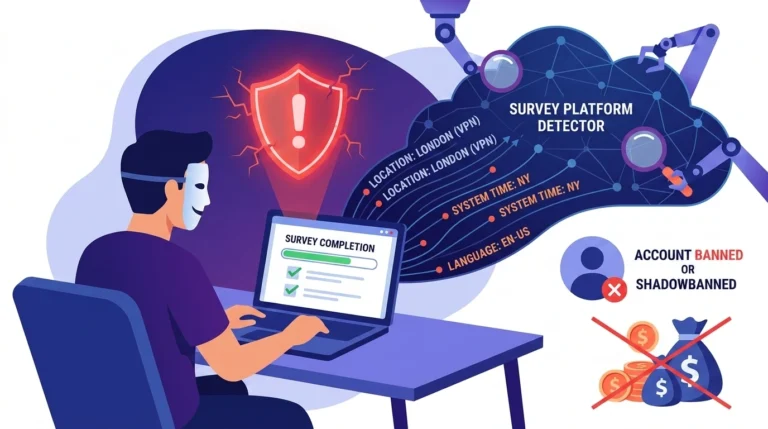
The behavioral patterns that trigger flags include completing surveys at unusual hours consistently, having IP addresses that suggest VPN usage, using multiple accounts from the same device, and exhibiting response patterns that match known bot signatures. These systems have become remarkably effective at separating genuine respondents from those gaming the system.

Shehar Yar, CEO at Software House
The Role of Predictive Analytics in Survey Fraud Detection
From my work with predictive analytics, I can say that algorithmic models are used to detect shifts in patterns, so abrupt or inconsistent answers are observable as sudden changes in response signals. When models register those shifts, they weaken the trust or credibility signals tied to an account, which in practice can reduce the likelihood of being matched to future targeted opportunities.
Typical behavioral triggers are abrupt changes in answer patterns or location and citation signals that diverge from past behavior. Fraud detection in this space has grown more sophisticated, relying on predictive models that look for subtle shifts rather than only raw volume.

Darren Tredgold, General Manager at Independent Steel Company
It’s Not Just One Question It’s Your Entire Profile
As Pratik Singh Raguwanshi explains, platforms use “real-time validation systems” that “cross-reference data points” throughout the entire survey. That means they’re not just checking if you hit the right button on the trap or attention check question.
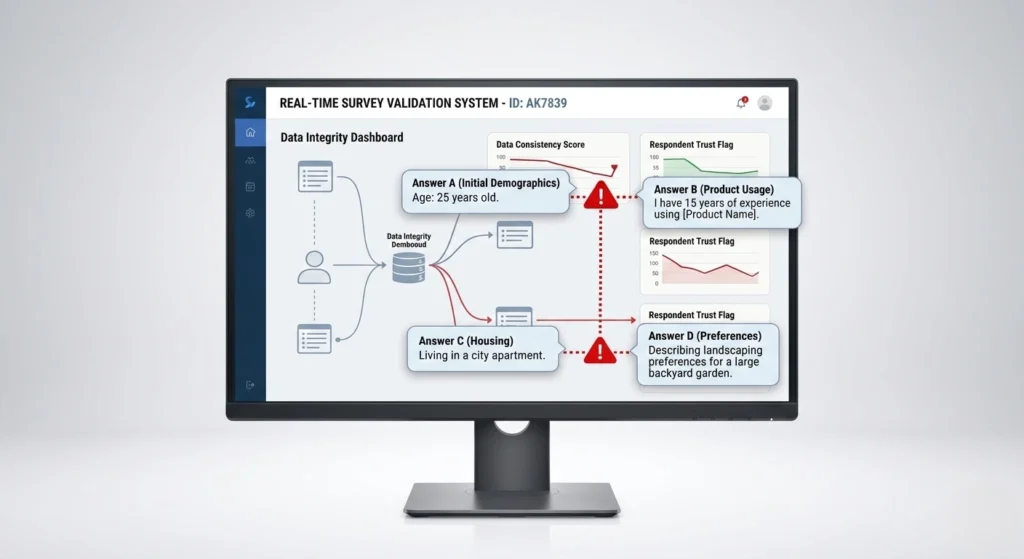
They’re checking if the 25-year-old who started the survey somehow has 15 years of experience using a product. They’re checking if the person who said they live in an apartment later describes their backyard landscaping preferences.
Every answer you give gets compared to every other answer you give.
The Trust Score the Secret Survey Credit Rating
Shehar Yar puts it bluntly: “Most platforms use a trust scoring system similar to a credit score. Every completed survey either increases or decreases your trust score based on quality signals.”
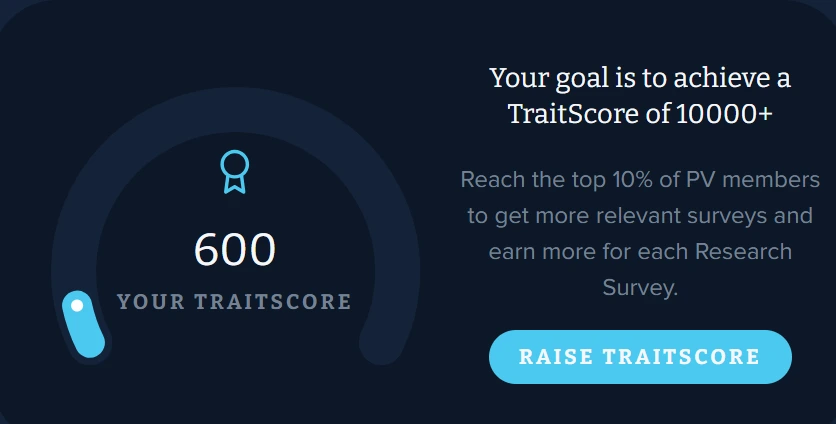
Think of it like your credit score, but for surveys. Every time you complete a survey cleanly consistent answer, appropriate timing, thoughtful open-ended responses your score ticks up. Every time you get flagged for inconsistency, speed through a survey, or give answers that don’t line up, your score ticks down.
And just like a credit score, once it drops below a certain threshold, the doors start closing.
Pratik confirms this: “As trust scores decrease below a specific threshold level, the survey respondee will be removed from accessing high-value research pools.” That means the $5 surveys disappear first then the $2 surveys, eventually, you’re left with nothing but 50-cent screeners that never pan out.
How Inconsistency Haunts You Later
Darren Tredgold explains that “algorithmic models are used to detect shifts in patterns.” When your answers suddenly change maybe you reported a different income level than you did six months ago, or your location shifted the models register those shifts and “weaken the trust or credibility signals tied to an account.”
That weakening happens in the background. You don’t get a notification. Your dashboard still looks the same. But gradually, the survey invitations stop coming.
The Technology Has Gotten Scary Good
If you’re thinking you can outsmart these systems, listen to what the experts are saying.
Shehar Yar, who built these systems, says they are “far more sophisticated than most respondents realize” and “remarkably effective at separating genuine respondents from those gaming the system.”
Pratik breaks down exactly what they’re using: “device fingerprinting technology, IP address reputation checks,” and even “natural language processing (NLP) technology on open-ended responses to ensure that responses are not only grammatically correct, but that they are also contextually relevant.”
That last one is huge. They’re not just checking that you wrote something in the open-ended box. They’re checking that what you wrote actually makes sense for the question. If you copy-paste the same generic response to every open-ended question, the NLP catches it.
Darren Tredgold adds that fraud detection now relies on “predictive models that look for subtle shifts rather than only raw volume.” It’s not just about catching cheaters anymore. It’s about predicting which respondents are likely to provide quality data before they even finish a survey.
What This Means for You
If you’re serious about making money from surveys, here’s what you need to take away from these experts:
- Your history matters: Every survey you take builds your profile. Inconsistent answers today mean fewer surveys tomorrow.
- Speed kills: Slow down read the questions, take the time the survey expects you to take.
- Be yourself consistently: If your income changes, update your profile. If you move, update your profile. Don’t let your answers drift away from your real situation.
- Open-ended questions count: Take an extra thirty seconds to write something thoughtful and relevant. The NLP is watching.
- Trust scores are real: You can’t see yours, but it exists. Treat every survey like it’s an investment in that score.
In a world of bots, speeders, and straight-liners, being a genuine, consistent human respondent is actually your competitive advantage. The platforms wants you; they’re just using increasingly sophisticated tools to separate you from everyone trying to game the system.
So next time you’re tempted to rush through a survey or fudge an answer to qualify, remember it’s not just about this survey. It’s about your trust score, your future invitations, and your consistent earnings.